The Gulf War of 1990 to 1991 was a short, intense conflict that pushed Iraqi forces out of Kuwait and reshaped the modern Middle East. A coalition led by the United States ran two main military operations, Desert Shield and Desert Storm, across roughly seven months. This Gulf War 1991 timeline walks through the key dates, the air and ground campaigns, and the verified figures behind one of the most studied wars of the late twentieth century.
How the Crisis Began
The war started with Iraq’s invasion of Kuwait on 2 August 1990. According to Encyclopaedia Britannica, Iraqi leader Saddam Hussein ordered the occupation to seize Kuwait’s oil reserves, cancel debts Iraq owed to Kuwait, and expand Iraqi influence in the region. Within hours, Iraqi units controlled Kuwait City.
The international response was fast. The United Nations Security Council condemned the invasion and imposed sanctions. The United States and Saudi Arabia agreed to a defensive buildup in the Gulf, and that deployment became known as Operation Desert Shield. Its stated purpose, as the US Navy’s official history notes, was the buildup of troops and the defense of Saudi Arabia. Desert Shield ran from 2 August 1990 until the air war opened in January 1991.
The Diplomatic Deadline
Diplomacy continued through the autumn of 1990 while forces gathered. On 29 November 1990, the Security Council passed Resolution 678. According to the UN record, the resolution gave Iraq until 15 January 1991 to withdraw from Kuwait and authorized member states to use “all necessary means” to force Iraq out after that date. The vote was 12 in favor, with Cuba and Yemen opposed and China abstaining.
Iraq did not withdraw. In the United States, Congress passed an authorization for the use of military force on 12 January 1991. When the 15 January deadline passed with Iraqi troops still in Kuwait, the legal basis for military action was in place.
The Air Campaign: Operation Desert Storm Begins
The coalition air offensive began on 17 January 1991. Britannica records that the bombing campaign first targeted Iraq’s air defenses, then struck communications networks, government buildings, weapons plants, oil refineries, bridges, and roads. Coalition aircraft had gained air supremacy by 28 January.
The air war also brought the conflict beyond the Iraq-Kuwait front. Beginning on 18 January, Iraq fired ballistic missiles, often called Scuds, at Israel. According to official Israeli government statistics cited by Human Rights Watch, the missile attacks killed a total of 13 people in Israel and the occupied West Bank. The strikes appeared aimed at drawing Israel into the war and splitting the coalition. Under heavy pressure from Washington, Israel did not retaliate, and the coalition held together.
The first major ground clash also came during the air phase. The Battle of Khafji, fought in and around the Saudi border town of Khafji from 29 January to 1 February 1991, was the first large ground engagement of the war. Coalition and Saudi forces retook the town after Iraqi units briefly captured it.
The Ground War: 100 Hours
The coalition ground offensive, sometimes called Operation Desert Sabre, launched on 24 February 1991. Forces drove north from northeastern Saudi Arabia into Kuwait and southern Iraq. Britannica reports that within three days, coalition forces had retaken Kuwait City against collapsing Iraqi resistance. The ground campaign lasted about 100 hours.
As Iraqi forces pulled back, retreating columns on Highway 80 north of Kuwait City were hit by coalition aircraft on the night of 26 to 27 February. That stretch became known as the “Highway of Death.” According to accounts compiled on the engagement, between 1,400 and 2,000 vehicles were struck or abandoned. Postwar studies found that many vehicles had been left empty before they were hit, and casualty estimates vary widely across sources.
President George H. W. Bush declared a ceasefire effective 28 February 1991, and Iraq agreed to honor coalition and UN terms. The Security Council later set out the formal conditions of the ceasefire in Resolution 687 in April 1991.
Key Dates at a Glance
| Date | Event |
| 2 Aug 1990 | Iraq invades Kuwait; Operation Desert Shield begins |
| 29 Nov 1990 | UN Resolution 678 sets 15 Jan deadline for Iraqi withdrawal |
| 15 Jan 1991 | UN deadline passes with Iraqi forces still in Kuwait |
| 17 Jan 1991 | Coalition air campaign (Operation Desert Storm) opens |
| 18 Jan 1991 | Iraq launches first ballistic missiles at Israel |
| 29 Jan to 1 Feb 1991 | Battle of Khafji, first major ground engagement |
| 24 Feb 1991 | Coalition ground offensive begins |
| 26 to 27 Feb 1991 | “Highway of Death” airstrikes on Highway 80 |
| 28 Feb 1991 | President Bush declares ceasefire |
The Cost and the Aftermath
The coalition was large by historical standards. Reporting on commander General Norman Schwarzkopf’s role describes an international force of around 750,000, including roughly 500,000 US troops and 250,000 from partner nations. Source counts of how many countries took part vary, with figures commonly given in the mid-30s to low 40s.
Coalition losses were relatively light for a war of this scale. United States deaths included 147 killed in battle and 235 from non-battle causes, with the United Kingdom losing 47 service members and France losing 2, according to figures compiled in standard reference accounts. Iraqi military casualties are harder to verify and estimates differ significantly between sources.
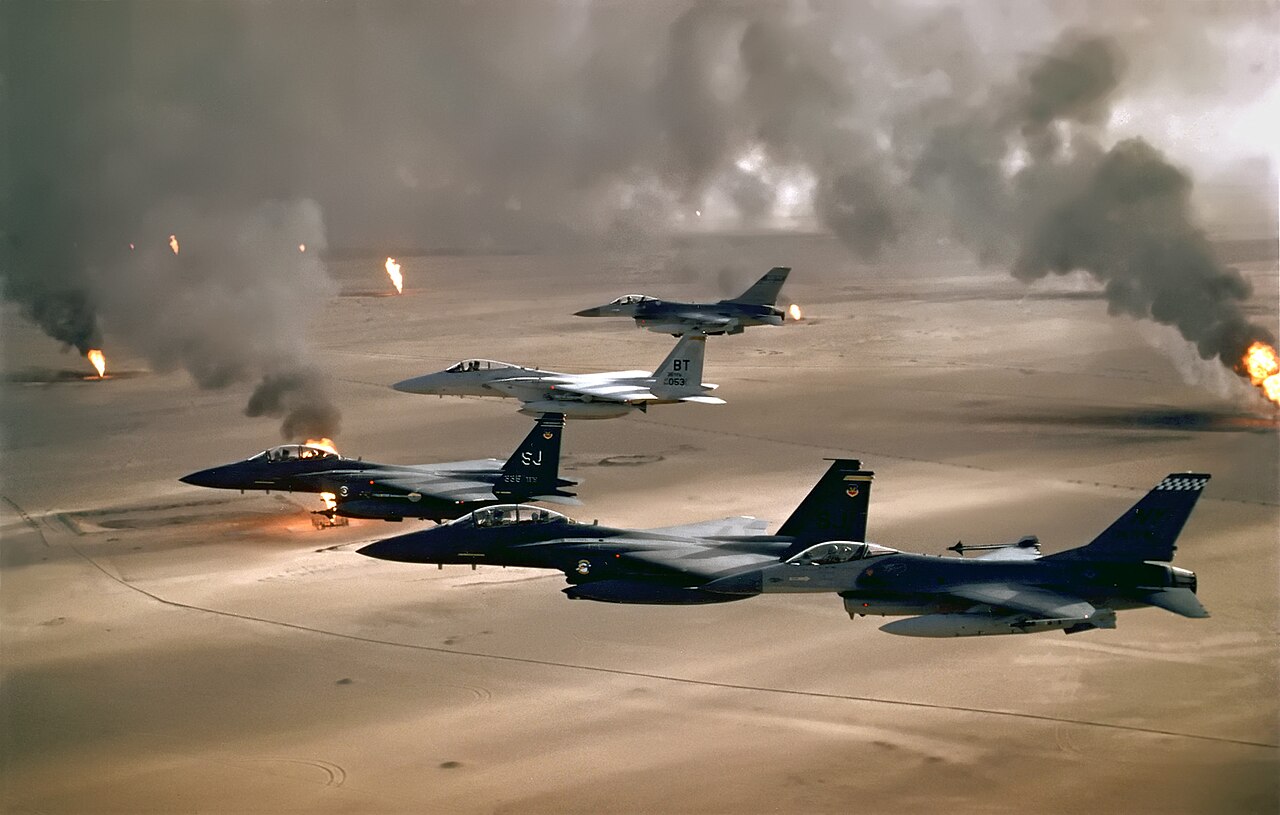
The environmental toll was severe. The US Environmental Protection Agency reported that retreating Iraqi forces set fire to or damaged more than 700 oil wells, storage tanks, refineries, and facilities in Kuwait. The Kuwaiti oil fires burned for months and released large volumes of smoke before the last well was capped late in 1991.
The 1991 war removed Iraqi forces from Kuwait but left Saddam Hussein in power. UN weapons inspections, sanctions, and no-fly zones followed through the 1990s, and the unresolved tensions fed into the later 2003 invasion of Iraq.
Frequently Asked Questions
How long did the 1991 Gulf War last?
The active conflict ran from Iraq’s invasion of Kuwait on 2 August 1990 to the ceasefire on 28 February 1991. The air campaign began on 17 January 1991, and the ground offensive lasted about 100 hours, from 24 February to the ceasefire.
What was the difference between Desert Shield and Desert Storm?
Operation Desert Shield was the defensive buildup of coalition forces and the protection of Saudi Arabia, running from August 1990 to mid-January 1991. Operation Desert Storm was the offensive phase, starting with the air campaign on 17 January 1991 and including the ground war that liberated Kuwait.
Why did Iraq fire missiles at Israel?
Iraq launched ballistic missiles at Israel beginning on 18 January 1991 in an apparent effort to provoke an Israeli military response. The aim was to strain the US-led coalition, which included Arab states. Israel did not retaliate, and the coalition stayed intact.
Closing Note
Operation Desert Storm remains a benchmark for coalition warfare in the modern era. The combination of a long air campaign and a fast ground push produced a decisive military result in weeks. The dates and figures above, drawn from reference works, official histories, and contemporary reporting, give a factual frame for understanding how the Gulf War unfolded and why its consequences shaped the region for years afterward.
Related Reading
- The Kuwaiti Oil Fires of 1991: An Environmental Disaster Explained
- Operation Desert Storm: How the 1991 Coalition Won the Gulf War
- Why Did Iraq Invade Kuwait in 1990? The Causes Explained
Updated: June 2026. Compiled by the GulfWar.org Editorial Team from public reporting by Reuters, AP, BBC, and Al Jazeera and from published historical records. This article is for informational purposes and does not take political sides.