When Iraq invaded Kuwait on August 2, 1990, it set in motion the largest military coalition assembled since the Second World War. Operation Desert Storm, the combat phase that followed, lasted roughly six weeks and ended with Iraqi forces driven out of Kuwait. This is how the Operation Desert Storm coalition came together, fought, and won.
From Invasion to Ultimatum
Iraq’s seizure of Kuwait drew an almost immediate international response. The United Nations Security Council passed Resolution 660 demanding withdrawal, then Resolution 661 on August 6, 1990, imposing a trade embargo on Iraq. According to Encyclopaedia Britannica, the most consequential step came with Resolution 678 on November 29, 1990, which authorized the use of force if Iraq did not withdraw by January 15, 1991.
While diplomacy played out, the military buildup ran in parallel under the name Operation Desert Shield. This defensive phase, lasting from August 1990 to mid-January 1991, was meant to protect Saudi Arabia and mass the forces needed for any offensive. By the time the deadline passed, a vast coalition stood ready in the Gulf.
Building the Coalition
The alliance led by the United States was unusually broad. Estimates of its size vary by how participation is counted, with sources citing figures from roughly 30 to more than 40 nations. The U.S. Army Center of Military History honors coalition partners from 31 nations, while other tallies run higher because they include states that offered financial, medical, or logistical support rather than combat troops.
By January 1991, coalition forces numbered around 750,000, including roughly 540,000 U.S. personnel, according to History.com. The largest military contributors were the United States, Saudi Arabia, the United Kingdom, and Egypt. France, Syria, and the Gulf Arab states also fielded forces. General Norman Schwarzkopf, commander-in-chief of U.S. Central Command, directed the overall military campaign.
Holding such a diverse group together was its own achievement. Arab and Western armies operated side by side, and the coalition had to keep that unity intact even when Iraq tried to fracture it by drawing Israel into the conflict.
The Air Campaign
Operation Desert Storm opened in the early hours of January 17, 1991. The Imperial War Museums record that the first strikes came from Task Force Normandy, a mix of U.S. Army Apache and Air Force Pave Low helicopters that knocked out Iraqi radar sites near the border, opening corridors for the aircraft that followed.
What came next was one of the most intensive air bombardments in military history. Over the course of the campaign, coalition aircraft flew more than 100,000 sorties and dropped tens of thousands of tonnes of ordnance against Iraqi command centers, airfields, supply lines, and fielded forces. The goal was to degrade Iraq’s ability to fight before any ground assault began.
Iraq’s main answer was the Scud missile. According to multiple defense and historical sources, Iraq launched roughly 88 of these ballistic missiles during the war. About 42 were aimed at Israel and the rest at coalition targets in the Gulf. The attacks on Israel were a deliberate attempt to provoke an Israeli response and split Arab members away from the coalition. Israel, under U.S. pressure and with Patriot air-defense batteries deployed, stayed out of the fighting, and the alliance held.
The 100-Hour Ground War
The ground offensive, sometimes called Operation Desert Sabre, began on February 24, 1991. It was built around a flanking maneuver that became known as the “left hook.” Rather than attack straight into Iraqi defenses in Kuwait, coalition armored columns swung far to the west through open desert, then turned to cut off and encircle Iraqi forces from behind.
The plan worked with remarkable speed. Iraqi units, already worn down by weeks of bombing, were unable to hold. President George H.W. Bush declared a ceasefire on February 28, 1991, ending major combat after roughly 100 hours on the ground. Kuwait was liberated, and Iraq pledged to accept coalition and U.N. terms.
One episode from the final days remains debated. As Iraqi forces retreated from Kuwait City, coalition aircraft struck a column of vehicles on Highway 80, an event the press dubbed the “Highway of Death.” Reports cited between roughly 1,400 and 2,000 vehicles hit or abandoned. Later studies, noted by Wikipedia’s account of the event, found that many vehicles had been abandoned before the strikes and that actual casualties among the fleeing troops were lower than early images suggested.
Key Facts and Timeline
- August 2, 1990: Iraq invades Kuwait. UN Resolution 660 demands withdrawal.
- August 6, 1990: Resolution 661 imposes a trade embargo. Operation Desert Shield buildup begins.
- November 29, 1990: Resolution 678 authorizes force if Iraq does not withdraw by January 15, 1991.
- January 17, 1991: Operation Desert Storm air campaign begins.
- February 24, 1991: Coalition ground offensive begins.
- February 28, 1991: President Bush declares a ceasefire. Kuwait is liberated.
Counting the Cost
The contrast in losses between the two sides was stark. Casualty estimates vary by source, especially for Iraq, but the figures below reflect commonly cited ranges from reputable references.
| Category | Coalition | Iraq |
| Military deaths | Roughly 300, including 147 U.S. battle deaths and 47 British deaths | Estimates range widely, commonly cited from about 8,000 to tens of thousands |
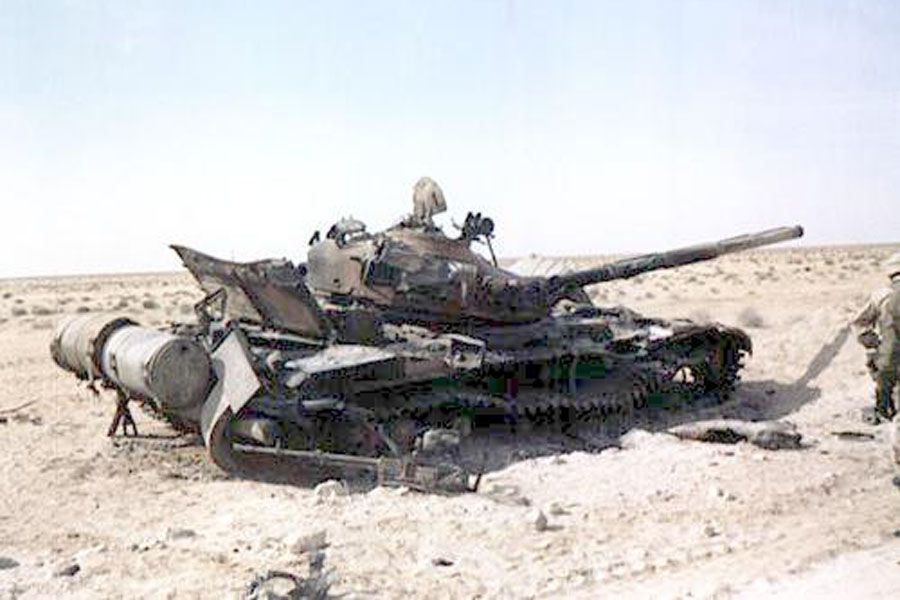
| Equipment | Limited losses | Thousands of tanks, armored vehicles, and artillery pieces destroyed or captured |
| Outcome | Kuwait liberated, coalition intact | Forces expelled from Kuwait, military heavily degraded |
Wide variation in Iraqi casualty estimates reflects the difficulty of verification in the chaos of retreat, and figures should be read as ranges rather than precise counts. U.S. battle deaths included losses from a Scud strike on a barracks in Dhahran, which historical accounts identify as one of the single deadliest incidents for American troops in the war.
Why the Coalition Won So Quickly
Several factors combined to produce such a rapid result. The coalition controlled the air almost from the start, which let it strike Iraqi forces with relative freedom while limiting Iraq’s ability to maneuver or resupply. Coalition forces also fielded more advanced equipment, including precision-guided munitions and superior armor, against an Iraqi army that had been weakened by years of war with Iran.
Just as important was the political design of the operation. The mission set by Resolution 678 was narrow, namely the liberation of Kuwait, and the coalition stopped once that goal was met rather than pressing on to Baghdad. That limited objective helped keep the diverse alliance together and gave the campaign a clear endpoint.
Frequently Asked Questions
How long did Operation Desert Storm last?
The combat phase ran from January 17, 1991, when the air campaign began, to February 28, 1991, when President Bush declared a ceasefire. That is roughly six weeks. The ground war itself lasted about 100 hours, from February 24 to February 28.
How many countries were in the Gulf War coalition?
Counts vary by source and by how participation is measured. The U.S. Army Center of Military History honors partners from 31 nations, while broader tallies that include financial and logistical contributors cite figures above 40. The largest military contributors were the United States, Saudi Arabia, the United Kingdom, and Egypt.
Why did the coalition not advance to Baghdad?
The United Nations mandate authorized force to liberate Kuwait, not to remove Iraq’s government. Coalition leaders chose to halt once Kuwait was freed, a decision that helped preserve the alliance, especially its Arab members, and kept the operation within its agreed legal aims.
A Decisive but Limited Victory
Operation Desert Storm restored Kuwait’s sovereignty in a matter of weeks and demonstrated what a unified, technologically advanced coalition could achieve. The war also left questions unresolved. Iraq’s leadership remained in power, and tensions in the region persisted through the following decade. As a military operation with a defined goal, though, the 1991 campaign stands as one of the clearest examples of coalition warfare in modern history.
Related Reading
- The Kuwaiti Oil Fires of 1991: An Environmental Disaster Explained
- Why Did Iraq Invade Kuwait in 1990? The Causes Explained
- Gulf War 1991: Complete Timeline of Operation Desert Storm
Updated: June 2026. Compiled by the GulfWar.org Editorial Team from public reporting by Reuters, AP, BBC, and Al Jazeera and from published historical records. This article is for informational purposes and does not take political sides.